The world is a scary place, mostly because of some of the people who inhabit it. Then there is accident, famine, sickness and natural disaster.
The world is a fabulous place, full of grandeur, amazing and intricate beauty, love, friendship, simple delights and heart-breaking sorrow. The future defies our every attempt to understand or predict it, and the simplest experiences can be interpreted widely differently, even by folks with similar backgrounds and viewpoints.
There are any number of systems that attempt to make sense of this life we find ourselves in. Many, perhaps most of them ascribe the mystery and chaos of the life we live to unseen forces. We don't understand because we don't see the "big picture." We don't understand because unseen players are introducing cause and effect that we know nothing about.
This conjecture forms a working hypothesis about how the world works. Some explanations involve one God, others many. Some have spirits animating everyday objects, others hosts of angels and devils constantly at work on unseen, unfathomable tasks. In some systems, we are working towards the embodiment of moral principles in life after life. For most of human history, one conjecture was as good as another, and there was no real way to tell which system was right, and which system was not.
Along comes the the scientific method, with its assumption of methodological naturalism. Actually, implicit in this approach to science is a hypothesis: the natural world can be explained without reference to supernatural causes or teleological assumptions. Several hundred years later, this hypothesis has been borne out over and over.
Though the results of science have generally been welcomed (even if all the technology that has come of it has been a mixed bag), it has necessitated a sea-change in how we view the world. Rather than an mysterious interplay of benign and malign unseen supernatural forces, the world is a chaotic interplay of natural forces.
This is seen as a direct affront to those who take a literally a spiritual tradition that ascribes events in this world (private and public, intimate and cosmic) to the action of unseen spiritual forces. Even though the evidence is pretty clear, that our early conjectures about the supernatural world is wrong, we are still act as if the old explanations (soul, spirit, gods, angels) are accurate, and the evidence before us (the fruit of science) is somehow wrong, or irrelevant.
Why? Because we are built to find significance. Because we experience coincidence (and intermittent re-enforcement is a powerful teacher). Because we want to believe that we matter, that what we do matters, that we are right and others are wrong. Don't get me wrong. I think that we are significant, that we do matter, and that there is a way to live (loosely speaking) that is better than others. And I believe that, in most of the world's religions, we have recapitulated that truth. But I also believe that most religions reflect these facts, rather than form the basis for moral and ethical action, community and purpose.
So the experience comes first, then the rejection of science. A person who holds that God personally intervenes in the day-to-day life of the believer, when faced with the fact that this is just not the way the world works, is forced to suspend belief in science (at least while they are acting as a person of faith). This is a small price to pay for certainty and a feeling of personal significance, they think.
I think they are wrong. It turns out to be a huge price to pay - and we see it in the religious and sectarian strife, the racial hatred, the destruction of our planet's atmosphere, the way we ignore authentic community and focus on purely personal issues of behavior.
The world is a chaotic system of natural cause and effect. This is evidently the way God made it, or God did not make it - there is not a third viable option. Just like we have had to give up the notion of sickness as caused by our neighbor's curse, or an eclipse as a struggle between good and evil, we need to base the way we view our search for significance and right action on the world as it is - not the world as we wish it were.
Friday, January 25, 2008


Wednesday, December 26, 2007
Not Your Old Time Religion
Though some Christians may pretend that conservative religious faith has remained somewhat constant through the centuries, what even the most conservative literalist believes today varies in significant ways from the world view of the early church. As late as the 1500s, it was assumed that angels and demons controlled the most mundane aspects of life. The vast territory that we now call the natural world did not exist in the minds of most people until very recently. Christian Europe believed that demonic forces directly and regularly caused things like illness, death, wasting of crops, barrenness, etc. that are now understood to have more "natural" causes.
This mindset lives on today. As quoted in the Times of India, "Officials at Nepal's state-run airline have sacrificed two goats to appease Akash Bhairab, the Hindu sky god, following technical problems with one of its Boeing 757 aircraft, the carrier said on Tuesday."
This is not to say that religion is unimportant. One of the themes I have been trying to develop on this blog is that we need to come to new understandings about the interplay of science and religion. Belief is bound up in what it means to be human, it would seem. Faith is an integral part of how we go about our lives. At the same time, much of our traditional religious frameworks are bound up in cosmologies and understandings of cause and effect that we no longer share with our spiritual fore bearers. We have a largely naturalistic view of the world, but our spiritual framework is defined by people who saw even the most mundane occurrences as fraught with supernatural agency.
Rather than argue that faith requires us to believe absurd things, we need to work out how to maintain faith in light of the massive shift in worldview that has overtaken us as the result of our study of the natural world.
Friday, December 14, 2007
We've Already Moved Past Biblical Literalism
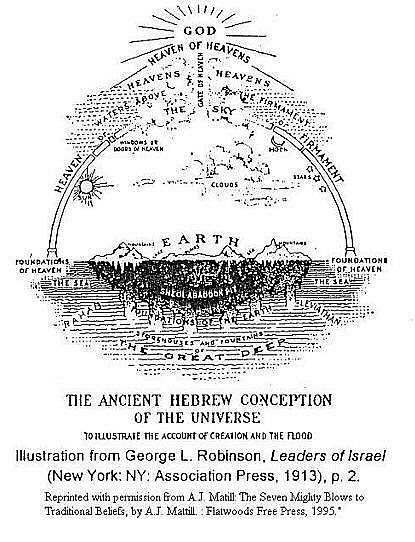
If you believe the earth rotates the sun, then you believe things that science has discovered that contradicts the bible. Do you extend your faith to a flat earth and a sun that moves across the sky?
In fact, you have changed the way you read the Bible such that you don't even think the Bible teaches that. The fact that Martin Luther thought that it did shows that it our interpretation that has changed, and not the Bible's teaching.
Science assumes naturalism because that is all it can study. It is like the old joke about a drunk looking under a streetlight for his car keys because the light is better there. Science assumes naturalism, not as a commitment to atheism, but because it won't work when the answer is "God did it."
This is where the gaps of the "God in the Gaps" theology comes from. When science can't find an answer, you can assume that we'll never figure it out, we might figure it out, or that God did it. Progress is only made in science when you assume that we might be able to fougre it out. Unexpectedly perhaps, this assumption has been so successful, there has been no reason to question it.
The big bang did happen. This is not speculation, it is based on evidence, and confirmed by experiment. The earth is not 6,000 years old - this is based on evidence, and confirmed by experiment. So it is hardly fair or accurate to say that these are two competeing views of the how we got here. A fair and balanced treatment of evolution would say that evolution is the only theory that explains the facts. Full stop.
The idea of the Big Bang is weird, no doubt. And you can believe that God did it, no doubt. But what God did not do is create the earth 6,000 years ago. What God did not do is create species from the mud, just as they are (or even mostly as they are) today. Just like a flat earth and a sun that is drug across the sky, modern discoveries give us challenges in reading the Bible. These are real challenges, but they should not be papered over by denying the age of the earth and the actions of evolution.
Sunday, December 09, 2007
Biblical Faith and Confidence in The Natural World
The level of comfort I have with evolution and other scientific explanations of the world and how it works is pretty high. But I do not call that confidence faith.
"Now faith is being sure of what we hope for and certain of what we do not see." (Hebrews 11:1) I do not have faith that gravity is at work. I do not need to hope that gravity shows up and does its thing, nor are its effects unseen. Evolution is the same - its effects are everywhere, and the evidence for evolution is everywhere.
One problem a Biblical faith must address is that a plain reading of the Bible lays out a world that was created 6,000 years ago and suffered a world-wide flood 4,500 years ago. Where all living creatures were within walking distance of the ark. A world where stopping the sun will lengthen the day and where Jesus went up into the sky to reach heaven, and was to return from the sky before his followers died. This is a book with two different creation accounts, two different 10 commandments, and irreconcilable differences in the chronology and activities of Jesus' life on earth.
These things are simply true about the Bible, and just like the fact of evolution, should in all honesty be faced. Some biblical literalists tell us that rather than face these facts, the facts should be denied, and if they can't be denied, that a Christian is supposed to make a virtue of believing things that are obviously not true (they call this faith - compare this with Hebrews 11:1 above, and you'll see that this is an innovation, and shares little with the notion of Biblical faith).
As a personal religion, I am OK with that (well, it makes me uncomfortable, but we all believe things that aren't true). I put these beliefs in the same category as astrology and palm reading.
What has me concerned is that there are now enough of these folks who believe that ignorance is a virtue that they are being successful in rolling back confidence in science. Educators are being fired for doing their jobs, teachers are being pressured to skip over the teaching of evolution, and pastors are pandering to this "appearance of godliness" by blaming the teaching of evolution for the world's ills.
It is important to live in the light as much as possible, in part because we risk making grave errors when we base our public and private lives on a lie. It is difficult work to figure out how to read the Bible in light of what we have learned about the natural world. But just like we managed to adjust our thinking about the Bible to Galileo's revelations, we can adjust to reading the Bible in light of what we've learned about the world via evolution and quantum mechanics.
Monday, November 26, 2007
Faith: Science and Religion
Science and religion use the word faith in two very different ways. Speaking of faith as it relates to the expectation that the earth will rotate around to face the sun again tomorrow is quite different than the faith praised in Hebrews 11 ("Now faith is being sure of what we hope for and certain of what we do not see"). To suggest that science is also based on faith, because some of the foundational laws of physics are not experimentally demonstrated but treated as "givens," is misleading.
True, Carl Popper (the influential philosopher of science) noted that the financial disclaimer "Past performance is no guarantee of future returns" is also true of inductive reasoning. But, just like investors view past performance as an indicator of future returns, many regard Popper's critique of induction as a kind of reductio ad absurdum argument - we have good reason to expect natural laws to remain in effect. Just because we can't be absolutely certain does not mean that we have no certainty at all. We go with successful investment funds because we expect the future to look like the past. Unlike funds, however, we so far have found no exceptions to the rule that the present continues to look like the past, as far as the laws of physics go - and so it is reasonable to expect the future to look like the past as well. This is a far cry from the Biblical notion of faith.
The Bible commends faith that holds firm in the absence of evidence. Good science encourage faith (if that is the right world at all) only in the face of compelling (even if not irrefutable) evidence.
Science is just an extension of careful observation and reasoning. We've been doing science for thousands of years. What enabled what we think of as modern science to transform the world's culture in a few hundred years seems to be a combination of the right political climate and a rejection of traditional explanations ("As above, so below"). That, and methodological naturalism.
Taken from this perspective, science and faith don't present any more of a conflict than did faith and the natural world for the author of Hebrews. The attempt to make science just another faith (and a religion on top of that) looks to me to be an attempt at undercutting the demand for faith. The author of Hebrews argues not that science is just as uncertain as religion, but that we have faith in the face of uncertainty. Rather than tear down science, Hebrews urges, build up faith.
Tuesday, November 20, 2007
Does Science Hate God?
Some creationists think that Douglas Futuyma provides a "smoking gun," proving a scientific bias against their faith, when he says:
"Evolutionary theory does not admit conscious anticipation of the future (i.e. conscious forethought)."
Futuyma seems to be saying that the theory of evolution has no room for the idea of guided processes - because, as in the rest of scientific explanations discovered to date, the world "works" - things have been successfully explained without resorting to "and then a miracle occurs." To say that evolution works without guidance is to say that it is a natural process, which does not require the intervention of God.
This is, in fact, a true statement about EVERYTHING that science discovers. Every scientific theory deserves the same criticism (God's intervention is not required). Think about this for a moment. This represents a sea-change in how people think about the world. So far, NO process identified to date requires the intervention of a deity to explain what goes on. Not the sun rise, thunder and lightening, crops, birth, death, the creation of the sun, moon, stars or earth. This is not what scientists expected when Western science got started in earnest, just a few hundred years ago.
If this is true (and it is), then why single evolution out for explicit criticism? I suspect because it runs afoul of the way some Christians (biblical literalists) interpret Genesis 1 and 2. If God did not fashion Adam from the mud some 6,000 years ago, then Jesus did not die for our sins (or so their argument goes). Millions of Christian do not share their perspective, but this does not matter to the literalists. It is their way or to Hell with you. What is more, the rest of science will get its turn. Chemistry, geology, cosmology - not to mention anthropology, archeology, history - the list goes on - will have to be heavily "edited" if the goal is conformity with biblical literalism. This is just another reason to resist the ongoing attempt to censor science in the name of piety. You may not care about the theory of evolution, but when they get around to something you do care about, it will be too late.
Of course science has implications for theology. If you believe that God rides a chariot across the sky, pulling the sun, you are in trouble (unless you believe in an invisible chariot, I guess). So, yes, evolution suggests that things happen in a particular way (using natural processes, not requiring God’s direct intervention). You can look at how the world works and see no God, you can see God as the creator, using natural processes to accomplish his purposes, or you can argue for the suppression of science because you disagree with its conclusion.
Biblicalism: Addressing the Shortfalls of Methodological Naturalism
Senator Brownback is on recording as advocating that we should just say no to scientific ideas that contradict conservative Christian theology. This is an idea that has far-reaching implications.
Let me flesh out the proposal - let's call it Biblicalism. The way Biblicalism proceeds in discovering how things work is: 1) identify all statements from the Bible that contain information about the natural world, and 2) set those down in a "Foundations of Science" textbook as "Givens." This would include the Bible's statements on cosmology, geology, chemistry, physics, biology, history, archeology, etc.
An "idea review board" would be set up, manned by Bible Scholars (only men, and members would be picked by a "literal-off", in which those who can explain how the most number of passages in the Bible are meant to be taken literally (exactly as written in the KJV) would be chosen). Any evidence that contradicts these Givens would be rejected. All explanations that do not fit with these Givens are rejected. Anyone who insisted in arguing for things that contradicts the Givens would be prohibited from publishing or teaching (otherwise, it just gets too messy, as the discussions over creation and evolution have shown).
You'd need to add some a new scientific discipline: Supernatural influence (giving input to other disciplines about how spiritual forces are impacting politics, morals, weather, geological processes like earthquakes and volcanoes, fashion, etc). They would also add steps to ostensibly "natural" processes to highlight God's part. For example, since "in Him we move, and breathe, and have our being" we'd need to add God's part to the study of pulmonology). We might want to consider banning mechanical ventilators, for example, because that is clearly breathing when God is no longer helping out. Those liberals who think the passage quoted is poetical must not be allowed to insinuate their materialistic philosophy into innocent minds; that way leads to madness!
You'd need fact checkers to identify when things are attributed to natural causes when in fact there are Givens at work. These errors would have to be corrected, and the violators punished. Sanctions are required, because most Givens will not actually improve the usefulness of the explanation (in fact, they will usually make them less accurate and useful, though more True), so people won't use them unless it is required.
Dispensation will have to be given for engineers to use approaches that contradict the Givens, because otherwise, they won't be able to actually make things work (for example, you'd need a non-Flood geology model to find oil and gas). This is probably best kept quiet, so perhaps we could develop guilds, with strict membership and secrecy requirements.
It would be best to restrict literacy and education in general, as it is a demonstrated fact that education leads to disputation of Givens. For example, in many conservative Christian circles, Seminaries are called "Cemeteries" because a graduate education the Bible leads so many students away from faith in the Givens.
I think that these modest proposals will solve most of the mistakes evident in modern science, and end attacks on the Bible.
Subscribe to:
Posts (Atom)
