Of course there are people who view science as giving them an intellectual justification for rejecting religion. In the same way, many people find that they must distance themselves from science in order to keep hold of their faith. Then there are some who try to keep hold of both. What is very clear is that this involves some compromise.
While some people insist they hold to a literal interpretation of the Bible (for example), they do in fact hold a much more liberal view than the original hearers. Obvious examples for conservative Christians are the fact that the earth circles the sun, the stars are not fixed in the sky, that snow is not stored in storehouses, and that creatures are not spontaneously generated from the earth (as Genesis 1 implies, and as was widely held until recently).
Science will from time-to-time demonstrate facts that contradict aspects of one religion or another. The constitution does not protect religion from such "attacks," nor should it. What is more normal, and what is happening here, is that science is being attacked by religion, and truth is being suppressed in order to support the YEC view of Genesis. This is also fine (though depressing), just not in the public education system.
One thing hasn't changed - some people think God is found in the gaps of our understanding about the natural world. I for one tire of the constant retreat to just beyond the frontiers of science, where my co-religionists throw taunts - "You'll never figure this one out!" Oh. "I meant this - you'll never figure this out!" Oh...
My own personal frustration with this anti-science position is that it sacrifices science to defend creationism.
Never mind that it encourages superstition and bigotry (because that is what is left when you remove the truth).
Never mind that it opens the door to astrology, para-psychology and a host of other superstitious errors demanding equal time on exactly the same basis as creationism is being ushered in.
Never mind that it teaches students that truth is whatever you want it to be - the exact mind state desired by racists and demagogues of all stripes.
Never mind that it waters down science by introducing all sorts of special pleading- a real turn-off for the few folks left who want to get on with it.
Never mind that it forces us to pretend that we know less than we do, and pretend that we seriously consider ideologically-motivated fantasy and reasoning from "first principles" as equal to the results of scientific discovery.
After all the special pleading, apologetics, distortions, lies and mis-information, it is truth that will have suffered, kids' education that will have suffered- and only to promote a YEC-view of Genesis. This is what is frustrating about the KBE decision.
For what it is worth, as the election after the last KBE decision like this showed, and as the recent vote in Dover emphasized, this kind of nonsense does not represent the will of the people. It represents how special interest groups can "storm the gates" and pack the board. When the general population wakes up, they rectify the situation. I'll be looking for ways to help rectify this come the next election.
Wednesday, November 09, 2005


Saturday, November 05, 2005
Why Does It Matter if the Bible is True?
The Bible bases its authority on a claim to be the story of God interacting with people. In a straightforward way, it makes unambiguous claims about people, places and specific occurrences. It uses these events to explain the nature of God, people and the purpose and direction of history. For example, the book of Mark contains a list of people who are ancestors of Joseph, Mary's husband, the mother of Jesus. Many of these people figure in the stories found in the books of Genesis through Chronicles, and in the prophetic books. The Bible treats these events as a demonstration of the nature of both God and people. If they did not happen, then the lessons derived from them lose authority. For example, the exile was God's response to a faithless Israel. If their captivity in Babylon had nothing to do with the quality of their interaction with God, then that changes our understanding of who God is and what he does (and is able to do). You may claim that the story is just as compelling even if it did not happen, and I will say that it is the difference between reading about having a gun pulled on you, and staring down the barrel of a gun pointed at you (I've done both, and for me at least, it is very different).
There is an alternative basis for authority- that many people have found the Bible meaningful, useful, and helpful even. This puts it on a level with a book like the Tao Te Ching (which claims no divinity for its authorship). All that is needed, perhaps, is some cultural insight to better understand what the author had in mind- no historicity is needed. Perhaps this is what is meant by the opening post in this thread. I will grant that any philosophy or religion can be admired and adhered to on this level, and it may even be viewed as in some way better or higher or finer that a philosophy that is rooted in the day-to-day. Again, I suggest it is like reading about being in love and being in love. I can understand how some people might prefer reading about it, after having been through it, but I sure vote for the real thing.
The Bible represents itself as an accurate record of the interaction of the Creator and his creation, from the beginning of time, to the end of time. If your accept that claim, you read it one way. If you reject that claim, you read it another way (or ways)- or, much more likely, just don't read it at all. If the question is, "Can the Bible be useful, even though it is largely fiction?" the answer is sure. If the question is, "Can you accept the Bible as an authoritative guide to the nature of God, people, and the purpose of history, even though many of its claims are false?" the answer probably should be no.
For many people, what gives them confidence in the Bible is that it is rooted in the facts of history. According to the Bible, God did break into history, influence the Pharaoh, the heads of the Babylonian and Persian empire, accurately describe the future, etc. In Isaiah, God is quoted as saying "My words do not come back to me empty, but accomplish the purpose for which they were sent." God is portrayed as an actor in history, not just an influencer of the private thoughts of people. It is these dry facts that demonstrate that this is God's nature. Eliminate the facts, and the very nature of God is changed. You may think this is for the better, others for the worse- but it does make a difference.
There is an alternative basis for authority- that many people have found the Bible meaningful, useful, and helpful even. This puts it on a level with a book like the Tao Te Ching (which claims no divinity for its authorship). All that is needed, perhaps, is some cultural insight to better understand what the author had in mind- no historicity is needed. Perhaps this is what is meant by the opening post in this thread. I will grant that any philosophy or religion can be admired and adhered to on this level, and it may even be viewed as in some way better or higher or finer that a philosophy that is rooted in the day-to-day. Again, I suggest it is like reading about being in love and being in love. I can understand how some people might prefer reading about it, after having been through it, but I sure vote for the real thing.
The Bible represents itself as an accurate record of the interaction of the Creator and his creation, from the beginning of time, to the end of time. If your accept that claim, you read it one way. If you reject that claim, you read it another way (or ways)- or, much more likely, just don't read it at all. If the question is, "Can the Bible be useful, even though it is largely fiction?" the answer is sure. If the question is, "Can you accept the Bible as an authoritative guide to the nature of God, people, and the purpose of history, even though many of its claims are false?" the answer probably should be no.
For many people, what gives them confidence in the Bible is that it is rooted in the facts of history. According to the Bible, God did break into history, influence the Pharaoh, the heads of the Babylonian and Persian empire, accurately describe the future, etc. In Isaiah, God is quoted as saying "My words do not come back to me empty, but accomplish the purpose for which they were sent." God is portrayed as an actor in history, not just an influencer of the private thoughts of people. It is these dry facts that demonstrate that this is God's nature. Eliminate the facts, and the very nature of God is changed. You may think this is for the better, others for the worse- but it does make a difference.
Wednesday, November 02, 2005
The Creationist Ghetto
Many of us have a commonsense reaction to the beauty and complexity of life - "Surely all this (myself included) is not an accident." What is more, many also believe that God says evolution didn't happen. If God said it didn't happen, and our "gut feel" is that evolution couldn't have happened, Darwin's theory is a hard pill to swallow. Evolution is not a "neutral" theory in this context; it is a direct challenge to the authority of God and our sense of place in the world.
Polls indicate that a significant number of adults reject evolution, and politicians, urged on by well-financed special interest groups and conservative religious leaders, have managed to galvanize them into voting their belief. As a result, there is strong political pressure that will (apparently) require public schools to teach that ID (and let's face it, Biblical Creationism) are valid "scientific" perspectives.
A triumph of the democratic system. The problem? Evolution, in fact, accurately explains what we see around us in the world, and successfully predicted such discoveries as DNA and dinosaurs with feathers. What is more, ID introduces religion into the classroom, which is unconstitutional. "If evolution is so strong, why worry? Just prove ID wrong," might be the response. The difficulty is that there is no way to prove ID wrong, because it makes no testable predictions. Jonathan Wells' recent attempt at responding to this criticism does not help, because even if true, the claim of design is not proven, because the mechanisms of evolution could also produce the same result. In what way does something Intelligently Designed differ from something brought into being through evolutionary processes? How can we tell that this aspect of a thing evolved, and this bit was designed? How and when was the designed bit introduced into the organism?
In the recent Dover trial, Michael Behe, a main proponent of ID, made two telling statements. First, he admitted that ID is not testable, because it has no mechanisms. Second, he offered the opinion that if ID is true, there is no point in looking for more detailed answers - ID is a science-killer. "So what?" you might respond- well, for one, you wouldn't be reading this on a computer without a scientific approach to the world. For another, we would be stuck in fear, ignorance, superstition and sickness - even more than we are - without a scientific perspective on things.
So teachers are left with the unpalatable situation of having to explain to bored and hostile students that truth is what you believe it to be. Truth not judged against any objective criteria is of limited value. Behe's arguments of complexity notwithstanding, concrete examples of ID last barely long enough for publication before they are explained away, and proponents reach for new examples. If this sounds like the old "God in the gaps" approach, that's because it is. What is more, by redefining science to consider non-natural explanations, you open the door to astrology, psychics of all persuasions, and the creation stories off all the religions - not just Christian literalists.
Rather than engage in the scientific process (for example, ID scientists could offer their own alternative explanations to their theories, and design experiments to prove their theories wrong- a normal part of mainstream science), we get well-crafted logical arguments. "Logic is fine," we should say, "but show me results! Make predictions, perform experiments! Gather data!" If James Dobson announced that he needed 10 million dollars to fund an experiment to prove that granite can form in decades under pressure, he would have the money in weeks. Where are these studies? Why won't creationists do the research?
Instead, Creationists are both the victim ("no one will publish our papers!"), and the bully ("We want ID in our schools, and we'll have it"). What creationists are doing is pushing conservative Christians into a ghetto of ignorance and fear. Ignorance because they are taught to distrust science, and to believe things (like a 6,000 year-old earth) that are not true. Fear, because they are told that the hostile world is out there trying to destroy them. It is a hostile world, but science is a tool, not an enemy. If Christians won't use the most powerful tool people have ever devised, they will end up being as relevant to our culture as the last group of science drop-outs, the Amish (but without the close-knit community).
Polls indicate that a significant number of adults reject evolution, and politicians, urged on by well-financed special interest groups and conservative religious leaders, have managed to galvanize them into voting their belief. As a result, there is strong political pressure that will (apparently) require public schools to teach that ID (and let's face it, Biblical Creationism) are valid "scientific" perspectives.
A triumph of the democratic system. The problem? Evolution, in fact, accurately explains what we see around us in the world, and successfully predicted such discoveries as DNA and dinosaurs with feathers. What is more, ID introduces religion into the classroom, which is unconstitutional. "If evolution is so strong, why worry? Just prove ID wrong," might be the response. The difficulty is that there is no way to prove ID wrong, because it makes no testable predictions. Jonathan Wells' recent attempt at responding to this criticism does not help, because even if true, the claim of design is not proven, because the mechanisms of evolution could also produce the same result. In what way does something Intelligently Designed differ from something brought into being through evolutionary processes? How can we tell that this aspect of a thing evolved, and this bit was designed? How and when was the designed bit introduced into the organism?
In the recent Dover trial, Michael Behe, a main proponent of ID, made two telling statements. First, he admitted that ID is not testable, because it has no mechanisms. Second, he offered the opinion that if ID is true, there is no point in looking for more detailed answers - ID is a science-killer. "So what?" you might respond- well, for one, you wouldn't be reading this on a computer without a scientific approach to the world. For another, we would be stuck in fear, ignorance, superstition and sickness - even more than we are - without a scientific perspective on things.
So teachers are left with the unpalatable situation of having to explain to bored and hostile students that truth is what you believe it to be. Truth not judged against any objective criteria is of limited value. Behe's arguments of complexity notwithstanding, concrete examples of ID last barely long enough for publication before they are explained away, and proponents reach for new examples. If this sounds like the old "God in the gaps" approach, that's because it is. What is more, by redefining science to consider non-natural explanations, you open the door to astrology, psychics of all persuasions, and the creation stories off all the religions - not just Christian literalists.
Rather than engage in the scientific process (for example, ID scientists could offer their own alternative explanations to their theories, and design experiments to prove their theories wrong- a normal part of mainstream science), we get well-crafted logical arguments. "Logic is fine," we should say, "but show me results! Make predictions, perform experiments! Gather data!" If James Dobson announced that he needed 10 million dollars to fund an experiment to prove that granite can form in decades under pressure, he would have the money in weeks. Where are these studies? Why won't creationists do the research?
Instead, Creationists are both the victim ("no one will publish our papers!"), and the bully ("We want ID in our schools, and we'll have it"). What creationists are doing is pushing conservative Christians into a ghetto of ignorance and fear. Ignorance because they are taught to distrust science, and to believe things (like a 6,000 year-old earth) that are not true. Fear, because they are told that the hostile world is out there trying to destroy them. It is a hostile world, but science is a tool, not an enemy. If Christians won't use the most powerful tool people have ever devised, they will end up being as relevant to our culture as the last group of science drop-outs, the Amish (but without the close-knit community).
Sunday, May 15, 2005
God in The Gaps
A recent story in Scientific American illustrates my objections to the current approach to redefining science (see the 2005 Kansas evolution debate for an example). The story concerns recent evidence that some values we think of as constant have changed over time, and mentions in passing how unconnected these constants seem to be to each other(here is a link to a summary).
This is the point when the Intelligent Design movement steps in with the comment, "See, isn't it obvious? God made the universe, and here is proof- even scientists agree that things are just too complex to have happened by chance, and the initial conditions too delicate to be an accident."
OK, I believe in God. I think God is the Creator. So here is proof that He exists, and so... I quit my job and go to church? Well wait, maybe what these discoveries mean (as implied in the article) is that there are yet-undiscovered-laws that bridge these constants. That things really aren't just arbitrary-we just haven't discovered the key yet. Understanding these higher laws could unlock all sorts of un-dreamed of possibilities. Shouldn't we take a peek?
Is this the inherent anti-God-bias showing up? Why not just admit that God did it and leave it at that? Why go looking for an explanation that does not include God? The short response is that “God did it” is not enough of an answer. Of course God did it- but how? This is the real question from a scientific perspective. This is what gets left out of the discussions of Intelligent Design, by the way- there is no explanation of the mechanism for what we see. It is these mechanisms that science strives to explain, and these mechanisms that are either missing or only very provisional in Intelligent Design.
No doubt some scientists (just like people in every other kind of occupation) do have an anti-God bias- but does that mean that there isn't a Theory of Everything that will tie things together? Or maybe we are just not be smart enough to figure it out, or we may have come along too late in the universe to see what would have been obvious earlier on. And even if there is a theory, and we discover it, it will not disprove God- because what we see with our electron-tunneling microscopes and X-Ray observatories and super-colliders and mathematical theories is what God did. The physical earth, the universe, our biology - everything we see, hear and do is only possible because of what God did. So if there are 11 dimensions, if superstrings exist, if all life on earth traces its ancestry from a common single-celled organism to a chemical soup, to the bi-products of super-novas, back to the big bang and before that, to some unimaginable pre-history- well, that is what God did, and we will just have to deal with it.
This is the point when the Intelligent Design movement steps in with the comment, "See, isn't it obvious? God made the universe, and here is proof- even scientists agree that things are just too complex to have happened by chance, and the initial conditions too delicate to be an accident."
OK, I believe in God. I think God is the Creator. So here is proof that He exists, and so... I quit my job and go to church? Well wait, maybe what these discoveries mean (as implied in the article) is that there are yet-undiscovered-laws that bridge these constants. That things really aren't just arbitrary-we just haven't discovered the key yet. Understanding these higher laws could unlock all sorts of un-dreamed of possibilities. Shouldn't we take a peek?
Is this the inherent anti-God-bias showing up? Why not just admit that God did it and leave it at that? Why go looking for an explanation that does not include God? The short response is that “God did it” is not enough of an answer. Of course God did it- but how? This is the real question from a scientific perspective. This is what gets left out of the discussions of Intelligent Design, by the way- there is no explanation of the mechanism for what we see. It is these mechanisms that science strives to explain, and these mechanisms that are either missing or only very provisional in Intelligent Design.
No doubt some scientists (just like people in every other kind of occupation) do have an anti-God bias- but does that mean that there isn't a Theory of Everything that will tie things together? Or maybe we are just not be smart enough to figure it out, or we may have come along too late in the universe to see what would have been obvious earlier on. And even if there is a theory, and we discover it, it will not disprove God- because what we see with our electron-tunneling microscopes and X-Ray observatories and super-colliders and mathematical theories is what God did. The physical earth, the universe, our biology - everything we see, hear and do is only possible because of what God did. So if there are 11 dimensions, if superstrings exist, if all life on earth traces its ancestry from a common single-celled organism to a chemical soup, to the bi-products of super-novas, back to the big bang and before that, to some unimaginable pre-history- well, that is what God did, and we will just have to deal with it.
Thursday, April 28, 2005
What is the conflict between faith and science?
A straightforward reading of Genesis 1 leads many to the interpretation that the universe was created in 6, 24 hour days. The genealogies after Genesis 1 suggest a timeframe of a few thousand years between this creation and the birth of Jesus.
Until a few hundred years ago, there was no particular reason to question this chronology. In Europe from the 14th century onwards, people began applying logic and observation to the world around them in new ways, with astounding results. New attention began to be paid to odd formations in rocks that appeared to represent creatures that no longer lived on earth. New observations of the heavens brought into question the nature of the universe, and the notion that earth was at the center of creation.
As people began to form these various observations into coherent theories, a picture sometimes emerged that was at odds with a "literal" reading of the Bible. Most of us recognize that sometimes the Bible is making a statement of fact, and sometimes it is drawing an analogy, or using some other device to convey its meaning. At the same time, it is clear that some statements in the Bible are meant to be taken as communicating facts about the physical earth, the universe, and living creatures. Because the Bible claims to be the inspired word of God, it is critical that we engage the issues raised by scientific discoveries that appear to contradict the Bible. Why? Because our answer will determine how we interpret the Bible, and what we believe God says to us though it.
Not everyone sees faith and science in conflict. Most of the early scientists were men and women of faith. Albert Einstein is quoted as saying that science was “Thinking God’s thoughts after Him.” It is the experience of many scientists and Christians that science and faith does not have to be in conflict. Strategies for dealing with faith and science have ranged from denying the conclusions of science (and attacking the motives of scientists), to dismissing anything in the Bible that is not supported by science.
This blog will explore some of the issues around the subject of science and faith, and provide a survey of the main approaches that Christians take towards science.
Until a few hundred years ago, there was no particular reason to question this chronology. In Europe from the 14th century onwards, people began applying logic and observation to the world around them in new ways, with astounding results. New attention began to be paid to odd formations in rocks that appeared to represent creatures that no longer lived on earth. New observations of the heavens brought into question the nature of the universe, and the notion that earth was at the center of creation.
As people began to form these various observations into coherent theories, a picture sometimes emerged that was at odds with a "literal" reading of the Bible. Most of us recognize that sometimes the Bible is making a statement of fact, and sometimes it is drawing an analogy, or using some other device to convey its meaning. At the same time, it is clear that some statements in the Bible are meant to be taken as communicating facts about the physical earth, the universe, and living creatures. Because the Bible claims to be the inspired word of God, it is critical that we engage the issues raised by scientific discoveries that appear to contradict the Bible. Why? Because our answer will determine how we interpret the Bible, and what we believe God says to us though it.
Not everyone sees faith and science in conflict. Most of the early scientists were men and women of faith. Albert Einstein is quoted as saying that science was “Thinking God’s thoughts after Him.” It is the experience of many scientists and Christians that science and faith does not have to be in conflict. Strategies for dealing with faith and science have ranged from denying the conclusions of science (and attacking the motives of scientists), to dismissing anything in the Bible that is not supported by science.
This blog will explore some of the issues around the subject of science and faith, and provide a survey of the main approaches that Christians take towards science.
What is the Scientific Method?
The scientific method is a tool to discover certain kinds of things about the world around us. Consider a tree. The scientific method would not be of much help to us if we wanted to plot an adventure story involving the tree, or wanted to know if it was a good abode for fairies, but if we wanted to know what purpose the leaves served, or what kind of soil it grew best in, the scientific approach is one of the most powerful tools ever devised.
Consider this illustration:
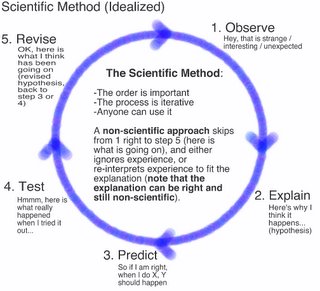
This model looks at the process of proving an idea- how many observations, reinforcing one another and independently verified, fit together into systems and areas of knowledge- and as these various systems provide mutual feedback and correction, these shared insights are used to direct, refine and finally produce a way of explaining some aspect of the world (a theory).
The diagram is labeled "idealized" because science is not really so cut and dry. For example, as often as not, a scientist is thinking about a particular kind of problem when she starts the cycle. Few, if any, people notice some random fact and start framing an experiment. More often, people are thinking about a particular kind of problem, and use this approach to figure out what is going on. What is important here is that instead of jumping to the conclusion, the person doing the experiment is asking good questions, performing tests to eliminate possible alternative explanations, and (hopefully?) listening to the data. This is not so much a procedure as a mindset.
Sometimes, we think we are closing in on an answer, and then everything is changed by new discoveries- for example, Newton's framework of physics was replaced by Einstein’s General Relativity- though keep in mind that Newton's laws still work- just not in as many instances as Einstein's - so this is really a case of a partial understanding being replaced by a more encompassing one.
And a few terms:
A fact is an observation that can be independently established by different observers.
A hypothesis is an explanation that accounts for observed facts. Click here for more.
A theory is hypothesis that fits all the observed facts. It has been tested by enough people over a long enough time to be generally accepted as true.
Given the above, a theory can never "graduate" to the status of a fact because they are not the same thing. Facts are the things explained by the theory. You can have so much confidence in a theory that it is not reasonable to deny the explanation. If facts are discovered that cannot be explained by the theory, then the theory is false, and has to be modified, or replaced by a theory that more accurately explains the facts. This is one reason why we are always reading about new discoveries that call some theory into question-it is the nature of science that we "know in part," and we revise our understanding as we go. This is actually a good thing, if it results in a more accurate understanding of our world.
There is no Single "Scientific Method"
"No single criterion yet formulated has succeeded in defining science completely, leading to two possible interpretations. Either we haven't found the all-sufficient definition yet, or it doesn't exist. The latter seems to be much more likely. Thus it is wrong to speak of the "Scientific Method". Rather, there is a constellation of scientific methods. The most robust definitions - those of widest applicability, most immune to abuse and capable of correcting errors - revolve around replication of results by independent observers and seeking ways to falsify theories."
http://www.uwgb.edu/dutchs/pseudosc/badmodl.htm
Consider this illustration:
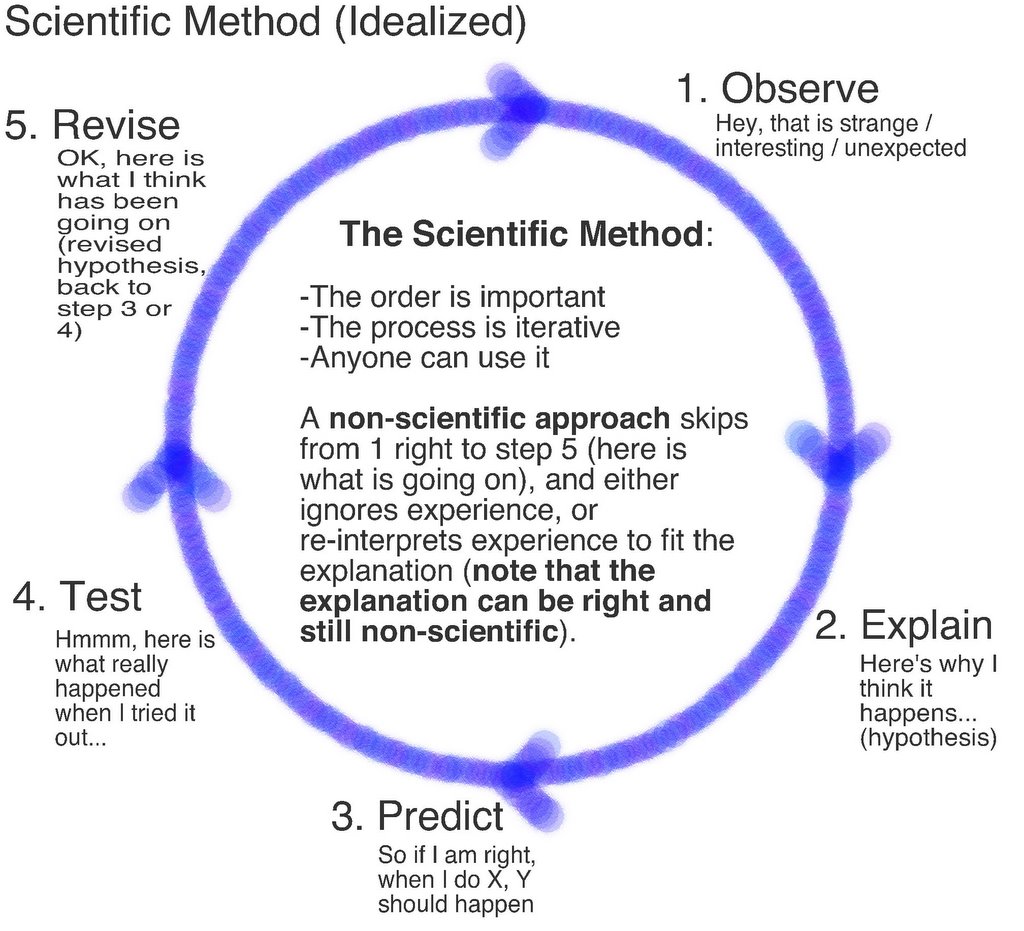
This model looks at the process of proving an idea- how many observations, reinforcing one another and independently verified, fit together into systems and areas of knowledge- and as these various systems provide mutual feedback and correction, these shared insights are used to direct, refine and finally produce a way of explaining some aspect of the world (a theory).
The diagram is labeled "idealized" because science is not really so cut and dry. For example, as often as not, a scientist is thinking about a particular kind of problem when she starts the cycle. Few, if any, people notice some random fact and start framing an experiment. More often, people are thinking about a particular kind of problem, and use this approach to figure out what is going on. What is important here is that instead of jumping to the conclusion, the person doing the experiment is asking good questions, performing tests to eliminate possible alternative explanations, and (hopefully?) listening to the data. This is not so much a procedure as a mindset.
Sometimes, we think we are closing in on an answer, and then everything is changed by new discoveries- for example, Newton's framework of physics was replaced by Einstein’s General Relativity- though keep in mind that Newton's laws still work- just not in as many instances as Einstein's - so this is really a case of a partial understanding being replaced by a more encompassing one.
And a few terms:
A fact is an observation that can be independently established by different observers.
A hypothesis is an explanation that accounts for observed facts. Click here for more.
A theory is hypothesis that fits all the observed facts. It has been tested by enough people over a long enough time to be generally accepted as true.
Given the above, a theory can never "graduate" to the status of a fact because they are not the same thing. Facts are the things explained by the theory. You can have so much confidence in a theory that it is not reasonable to deny the explanation. If facts are discovered that cannot be explained by the theory, then the theory is false, and has to be modified, or replaced by a theory that more accurately explains the facts. This is one reason why we are always reading about new discoveries that call some theory into question-it is the nature of science that we "know in part," and we revise our understanding as we go. This is actually a good thing, if it results in a more accurate understanding of our world.
There is no Single "Scientific Method"
"No single criterion yet formulated has succeeded in defining science completely, leading to two possible interpretations. Either we haven't found the all-sufficient definition yet, or it doesn't exist. The latter seems to be much more likely. Thus it is wrong to speak of the "Scientific Method". Rather, there is a constellation of scientific methods. The most robust definitions - those of widest applicability, most immune to abuse and capable of correcting errors - revolve around replication of results by independent observers and seeking ways to falsify theories."
http://www.uwgb.edu/dutchs/pseudosc/badmodl.htm
Does Science Discover Truth?
Some people argue that the assumptions behind science blind scientists to reality. By searching for naturalistic answers, scientists refuse to consider supernatural explanations. As a result (some would say), by definition, scientists are unable to "discover" facts that would support faith. They might go on to say that the entire educational establishment, hostile to faith, rejects and ridicules any attempt to bring faith into science, and even evidence that might support, for instance, a young age for the earth is ignored. This perception is strengthened by a number of scientists who are hostile to religion, and by a definition of science that specifically excludes the consideration of super-natural explanations.
On the other hand, the purpose of science is to uncover the mechanics of how things work-in specific. Ultimate answers like "God made it" does not add much to our understanding of blood clotting, for example (though it might enlarge our sense of awe). I think that part of the problem is that we have confused science with Truth, and think that if there is not a scientific answer, there is no answer to be found. Some scientists do hold that there is nothing but matter, and that everything that happens is only the interplay physical systems- but they are not speaking as scientists when they make these kinds of statements; they have become philosophers. Scientists can hold opinions about the nature of ultimate reality, just like theologians can hold opinions about the quantum mechanics- but in each case, they run the risk of arguing outside of their areas of expertise.
How God chooses to manifest in our lives, and how God interacts with the physical universe may not be discoverable, except through the eyes of faith. Seeking to validate our faith through science may be expecting too much of the discipline. This is not to say that faith is not grounded in the physical world, but that God's creation is so well made that it does not require "propping up" to function, and has no "holes in the fence" through which we can peek to see the hand of God at work.
Others suggest that there is no reality to discover. How we experience the world is created by consensus (or our preconceptions). If we had a different consensus, we would have different laws of physics. From this perspective, scientists document our shared habits of belief more than discover basic principles about the universe. Interestingly, this is a difficult charge to defend against, because we have little choice other than to act as if the world we find ourselves in is real (just try not paying your bills!). In any event, this is not a Christian objection to science, as Christians do believe that God (and not us) made the world.
All people bring their assumptions with them to any human endeavor. As well, reality is larger and more subtle than any one of us experience. All the same, I believe that something unusually powerful is indeed uncovered by scientists. What is being uncovered is nothing less than what God has done in the universe. Of course, this work is being done by people, with all sorts of motives, prejudices, agendas, and different levels of skill, experience, intellect... which is why we have the practice of peer review and reproducible experiments, and why controversial ideas take some time to be accepted.
As poor a system as this might be, I cannot imagine that making science a matter of popular opinion makes much sense either. It is not only Christians that have a bone to pick with science. Some Eastern religions question the very notion that there is a reality to discover. Certain groups deny that various historical events occurred; different religions have trouble with even fairly recent anthropology. Non-specialists have trouble with the math that underpins much of modern physics, and the chemistry & biology behind medicine. Given this, does it make sense to determine scientific fact by popular vote? Based their popularity, should we add astrology and numerology to our science curriculum?
Discontinuity or Progressive Change?
One of the things that is not always obvious when we read about new discoveries is that these new discoveries are most often refinements or extensions to explanations of the world around us. For example, recently a scientist has reported that he believes he has demonstrated that the speed of light is not constant. But this actually represents progress in understanding the universe- General Relativity would still be useful and accurate (Just as Newtonian physics is still used, though it has been superseded by General Relativity). So we may be "honing in" on the truth, rather than starting all over again. This matters because, if science is discovering random facts, and our theories veer from one explanation to another, it would be reasonable to assume that "anything is possible," and a theory that is proved wrong today could be proved right tomorrow. What seems more likely is that we do not discard what has been proved right so far, but discover deeper or more fundamental theories that account for more of what we see in the world.
In Summary:
"Science is not merely a collection of facts, concepts, and useful ideas about nature, or even the systematic investigation of nature, although both are common definitions of science. Science is a method of investigating nature--a way of knowing about nature--that discovers reliable knowledge about it."
http://www.carleton.ca/~tpatters/teaching/climatechange/sciencemethod.html
On the other hand, the purpose of science is to uncover the mechanics of how things work-in specific. Ultimate answers like "God made it" does not add much to our understanding of blood clotting, for example (though it might enlarge our sense of awe). I think that part of the problem is that we have confused science with Truth, and think that if there is not a scientific answer, there is no answer to be found. Some scientists do hold that there is nothing but matter, and that everything that happens is only the interplay physical systems- but they are not speaking as scientists when they make these kinds of statements; they have become philosophers. Scientists can hold opinions about the nature of ultimate reality, just like theologians can hold opinions about the quantum mechanics- but in each case, they run the risk of arguing outside of their areas of expertise.
How God chooses to manifest in our lives, and how God interacts with the physical universe may not be discoverable, except through the eyes of faith. Seeking to validate our faith through science may be expecting too much of the discipline. This is not to say that faith is not grounded in the physical world, but that God's creation is so well made that it does not require "propping up" to function, and has no "holes in the fence" through which we can peek to see the hand of God at work.
Others suggest that there is no reality to discover. How we experience the world is created by consensus (or our preconceptions). If we had a different consensus, we would have different laws of physics. From this perspective, scientists document our shared habits of belief more than discover basic principles about the universe. Interestingly, this is a difficult charge to defend against, because we have little choice other than to act as if the world we find ourselves in is real (just try not paying your bills!). In any event, this is not a Christian objection to science, as Christians do believe that God (and not us) made the world.
All people bring their assumptions with them to any human endeavor. As well, reality is larger and more subtle than any one of us experience. All the same, I believe that something unusually powerful is indeed uncovered by scientists. What is being uncovered is nothing less than what God has done in the universe. Of course, this work is being done by people, with all sorts of motives, prejudices, agendas, and different levels of skill, experience, intellect... which is why we have the practice of peer review and reproducible experiments, and why controversial ideas take some time to be accepted.
As poor a system as this might be, I cannot imagine that making science a matter of popular opinion makes much sense either. It is not only Christians that have a bone to pick with science. Some Eastern religions question the very notion that there is a reality to discover. Certain groups deny that various historical events occurred; different religions have trouble with even fairly recent anthropology. Non-specialists have trouble with the math that underpins much of modern physics, and the chemistry & biology behind medicine. Given this, does it make sense to determine scientific fact by popular vote? Based their popularity, should we add astrology and numerology to our science curriculum?
Discontinuity or Progressive Change?
One of the things that is not always obvious when we read about new discoveries is that these new discoveries are most often refinements or extensions to explanations of the world around us. For example, recently a scientist has reported that he believes he has demonstrated that the speed of light is not constant. But this actually represents progress in understanding the universe- General Relativity would still be useful and accurate (Just as Newtonian physics is still used, though it has been superseded by General Relativity). So we may be "honing in" on the truth, rather than starting all over again. This matters because, if science is discovering random facts, and our theories veer from one explanation to another, it would be reasonable to assume that "anything is possible," and a theory that is proved wrong today could be proved right tomorrow. What seems more likely is that we do not discard what has been proved right so far, but discover deeper or more fundamental theories that account for more of what we see in the world.
In Summary:
"Science is not merely a collection of facts, concepts, and useful ideas about nature, or even the systematic investigation of nature, although both are common definitions of science. Science is a method of investigating nature--a way of knowing about nature--that discovers reliable knowledge about it."
http://www.carleton.ca/~tpatters/teaching/climatechange/sciencemethod.html
Subscribe to:
Posts (Atom)
